
Professional Services Growth Lifecycle™
The Professional Services Growth Lifecycle™ is OTM’s proprietary model that maps how professional services firms actually grow from inception to scale-readiness and beyond. It helps firms clearly identify where they are today, what is true about that stage, and what must happen to progress. Every firm operates within a Growth Stage, and each stage comes with its own priorities, constraints, and proof points that must be achieved to move forward.
The OTM Path to Growth® is the system designed to help firms move through those stages intentionally. Built for firms that have achieved traction, it provides the strategic foundation, decision frameworks, and operational discipline needed to turn momentum into consistent, scalable growth.
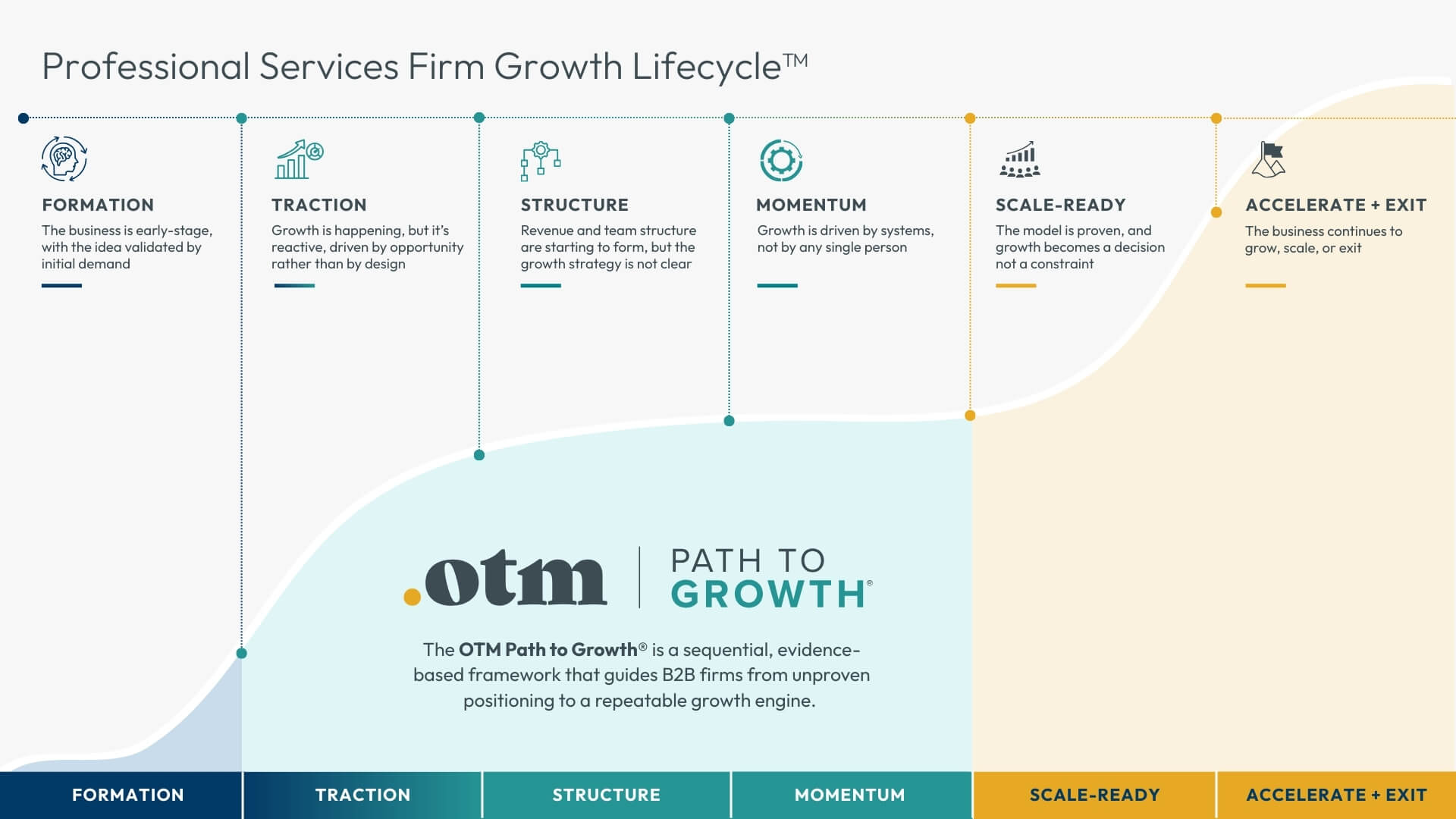
Where Is Your Firm Right Now?
Stage 1: Formation
Defining Characteristic: The business is an idea with early proof of demand, not an operation.
A professional with expertise and ambition is still working inside someone else’s business, freelancing, or assembling early collaborators. There is energy and conviction but no structured offering, no defined market position, and no real infrastructure. Revenue comes entirely from the founder.
What moves a firm out: The founder commits full-time, acquires enough clients to sustain the business, and begins to see demand that exceeds personal capacity to deliver.
Stage 2: Traction
Defining Characteristic: Growth is happening, but it’s reactive, driven by opportunity rather than by design.
Clients are coming in, often faster than expected. Revenue is growing. But the business runs on the founder’s willpower, not on systems. Hiring starts out of necessity, not strategy. The founder is selling, delivering, managing, and making every decision. Nothing about how work gets done is repeatable or documented.
What moves a firm out: The firm proves its strategy. Positioning and messaging have been validated through real buyer response. The ICP is defined. The strategic foundation required for structured growth has been established.
Stage 3: Structure
Defining Characteristic: The firm has a validated growth strategy and is now building the tactical infrastructure to execute against it.
The strategic foundation has been proven. Positioning is validated. The ideal client profile is defined. The work shifts to building the infrastructure that makes growth repeatable: a defined sales process, marketing aligned to sales priorities, and systems for pipeline visibility and accountability. The founder is still likely the primary seller. Referrals drive 80–90% of new business. Pipeline visibility is limited. Pricing and packaging may be inconsistent. But the firm knows what it’s building toward because the strategy has been tested.
What moves a firm out: The firm has built the infrastructure for consistent go-to-market execution and resolved enough operational bottlenecks that the team, not just the founder, can drive growth activity. The tactical mix has been tested and validated.
Stage 4: Momentum
Defining Characteristic: Growth is driven by systems, not by any single person.
The bottlenecks that defined the Structure stage have been resolved or are actively managed. The leadership team is functioning with autonomy. The go-to-market engine is running and producing results. The question shifts from “can we execute?” to “do we know what a dollar invested returns?”
What moves a firm out: The firm achieves predictability. Conversion rates are known. At least two to three channels are proven and repeatable. Leadership trusts the forecast. The relationship between investment and outcome can be modeled.
Stage 5: Scale-Ready
Defining Characteristic: Growth is a decision, not a constraint.
The model is proven. The firm knows what works, what each channel produces, and what levers to pull. Growth is limited by investment and capacity, not by strategy or systems. Adding budget to proven channels produces proportional results. Multiple people can sell effectively. Pipeline forecasting is reliable.
What Comes Next
Scale-Ready is the milestone most firms are working toward—the point where growth is no longer constrained by strategy, but by time and capital. The model works. The systems are proven. What remains is how aggressively the organization chooses to pursue the opportunity ahead.
From this position, firms have several paths available. Some choose to accelerate growth, doubling down on the strategies that brought them here and expanding into new markets. Others explore new divisions, acquisitions, or adjacent offerings that build on their existing momentum. And for some founders, reaching scale-ready creates the option to exit while the company is at its strongest, realizing the value they’ve built.
But regardless of experience, the growth path itself remains consistent—the same stages, the same proofs, and the same milestones that define a company becoming truly scale-ready.
Disruption and Maturity
It’s also important to recognize that disruption can occur at any point in the lifecycle. Markets shift, technologies evolve, and competitive landscapes change. This is the nature of operating in environments that never stand still.
Over time, these dynamics create two forms of maturity that we often see in organizations: operational maturity and organizational maturity. The two don’t always develop at the same pace. A first-time entrepreneur may take longer to move through the lifecycle as they learn and build systems along the way, while a seasoned operator may progress more quickly by applying lessons from prior ventures.
But regardless of experience, the growth path itself remains consistent—the same stages, the same proofs, and the same milestones that define a company becoming truly scale-ready.