
When a software bill gets long enough, the instinct is to cut it. The real cost of deleting a tool from your tech stack is the work, the data consistency, and the product decisions you take on in its place, and none of that appears on the bill you're trying to shrink.
A tech stack audit is a quarterly review that catches tool sprawl by asking one question about every tool on the bill, which is whether it's still doing the job it was bought for and what it would cost your team to remove it. For a firm working through a growth ceiling between $2M and $15M, the answer is rarely obvious, because a tool can look idle while a client depends on it, or look essential while a plan limit caps its best feature.
The renewal date is the wrong time to ask the question
Most of the software bills we look at share the same shape. A tool got bought to solve a problem, or sometimes a problem nobody had quite named yet, and the hope was that the tool would do the solving. A year later the firm is paying full price for a fraction of its use.
Every platform has sub-features nobody has gotten around to trying, but the waste that matters comes from tools that stopped doing a job and kept billing at full price. Across the stacks we review, it's normal to find a firm spending twice what it needs to while using less than half of the relevant features.
Software used to change slowly. You bought a tool, it did roughly the same thing for three years, and renewal was a reasonable time to ask whether it was still worth it. That's not how it works now. Every platform keeps adding features, so the overlap between tools grows every quarter. Call recording and transcription is the obvious case, because the standalone tool you pay for now competes with features inside your video platform, your CRM, and probably two other things already on the bill. Each release shrinks the reason a separate tool exists.
We watch this on purpose. A few bots crawl the release notes and changelogs for our sales, finance, and infrastructure platforms three times a week, bring back what shipped, and flag what applies to us. Nobody reads changelogs for fun, and at the pace things ship now, nobody could keep up by hand.
What tool sprawl looks like in practice
One firm we work with was paying for a 10-client license on a tool it used for exactly one client, as a courtesy to that client. Nobody had asked whether a simple $5 automation could manage it. It could, and it did. That one isn't crazy by itself, but the pattern is.
The pattern shows up well beyond our client stacks. Nexthink's analysis of 6.12 million devices found that almost half of installed software and licensed SaaS applications went unused.
How we replaced our proposal tool
We run this process on ourselves, and the clearest case so far is our proposals. For years we were choosing between two kinds of tool. Slide-builder proposal software gave us full creative flexibility, but every page was a slide we had to build and maintain by hand, so every proposal became a custom deck. The quote feature in our CRM went the other way, structured and turnkey, but it made a creative firm look overly corporate and put milestones and deliverables into what was effectively one field, so we lost the ability to separate them and manage them visually.
Neither was the best way to do the job, because the job was never only producing a document. It was producing something that reads the way clients expect from us and still carries the structure a contract needs.
So we built it. Every proposal is structured section by section, and inside each section the content is dynamic, generated from the templates, context, and frameworks we'd already built and still ours to change. That solved a long list of pain points on the sales side, and in July 2026 we deleted the standalone tool. Nothing has crept back since. Because we own the system we keep improving it, and we ship a functional change about every three or four weeks, some of which let us capture opportunities we couldn't before.
What deleting a tool actually costs
Deleting a tool costs more than the subscription you save, because when you build the capability yourself you become the product manager. That cost never shows up on the software bill.
Our system has to live inside our existing data structure and data lakes. Our proposals double as our contracts, and we can't have pipeline reporting and close rates scattered across systems, so everything the tool produces flows back into HubSpot. We had to build it around data consistency before we could build it around anything else. It also has to work the moment someone needs it, because nobody can deploy a code change in the middle of writing a proposal that was due yesterday.
AI changed the math here, and it's worth being precise about how. It lowered the barrier to features, so getting a tool to do what you need is no longer the hard part. The hard part is the data, the product management, and deciding what the feature set should be, and that barrier didn't move. The same dependence on data and context shows up in why AI adoption stalls at professional services firms.
We hold ours loosely. It earns its place today by a wide margin, but if what we built becomes something you can simply buy, we may move back to an off-the-shelf platform so we aren't maintaining our own forever. We built it so that we could.
Fewer tools is not the goal
Tool consolidation is not the answer in every case, because a tool earns its place by fit, not by being the only one left standing. We've worked through stacks where one unified platform could be replaced by two specialized tools that each did their job better and often cost 80 percent less. Two tools where you had one is rarely the outcome anyone hopes for, but the test was never the count.
Sometimes the plan is the giveaway. We've seen a website visitor identification tool running at full price on a plan that capped identifications at 10 a day, which meant the feature the firm leaned on most was the most restricted one. The firm was paying for the whole tool and getting a sliver of it.
Three questions for your tech stack audit, every quarter
Pull the software bill this week, then ask three questions about every line over a few hundred dollars a month. The same questions work for marketing and sales tools such as call recording, website visitor identification, and proposal software.
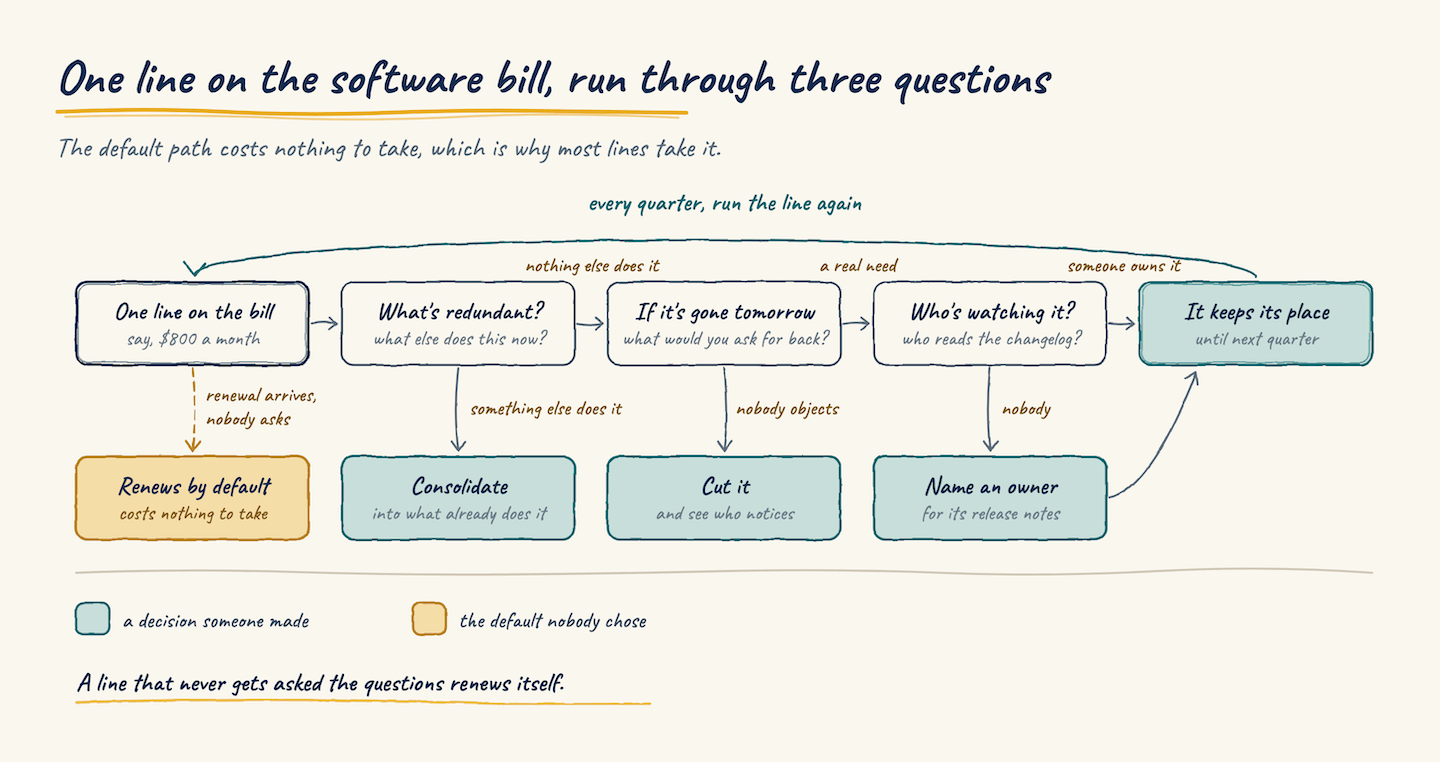
What's redundant?
Ask what else you already pay for that now does this job. Ask it every quarter, not once, because the overlap grows with every release.
If I cut it tomorrow, what would you ask me to bring back?
Put it to the people who use the tool in plain terms. "We're spending $800 a month on this. If it's gone tomorrow, what's your objection, what would you ask me for, and is this the right tool to do that?" This is the question that surfaced the 10-client license.
Who's watching it?
Every department should list its major tools, and someone should own each one's release notes. Otherwise you find out at renewal that something you already pay for started doing the job two quarters ago. An owner who reads release notes is also the person who spots redundancy, which makes this question support the first one.
Some tools you don't change lightly, since your CRM isn't going anywhere because of a quarterly review. Almost everything else on the bill should have to earn its place again.
Why this belongs in your growth system
The software stack is part of what a growing firm is trying to scale. Nothing scales until it's proven, and that includes the tools underneath your marketing and sales. It's one reason we look at tooling when we map how a firm's growth engine fits together. The Marketing Ops Maturity Assessment is a free, 10-question way to see where your marketing operations stand on strategy, systems, and team alignment, and it suggests the two or three moves that matter most.
Start with one question about your own stack. Which line on your software bill would nobody notice if it disappeared?
Frequently asked questions
What is tool sprawl?
Tool sprawl, sometimes called tech sprawl, is the gradual buildup of overlapping, underused, or ownerless software subscriptions. It usually happens one reasonable purchase at a time, and it shows up as cost nobody can tie to a specific job.
How often should a firm review its software?
Quarterly. Annual reviews tied to renewal dates happen too late to change the decision, and vendor feature releases make overlap grow between reviews.
How do you run a tech stack audit?
List the jobs each tool performs, flag any job covered by more than one tool, ask the people who use each tool what they would want back if it were cut tomorrow, and assign an owner to every tool that stays.
How do you run a martech stack audit?
A martech stack audit follows the same steps as any tech stack audit, applied to the tools that support marketing and sales, such as call recording, website visitor identification, and proposal software. Ask what's redundant, what the team would want back if it were cut, and who owns each tool's release notes.
Should you build custom software or buy off the shelf?
Buy when an off-the-shelf tool does the job you need done, and build when no option fits the job and you can own the data and the product decisions. We built our proposal system because neither slide-based software nor our CRM's quote feature fit, and we hold it loosely, since we may move back to an off-the-shelf platform if what we built becomes something you can buy.
Is it worth replacing a software tool with a custom system?
Only when the savings exceed the ongoing cost of owning it. A custom system needs someone to manage changes and keep data consistent, and that time rarely appears in the original estimate.